
Heat Flux Wearables: The Missing Signal in Metabolic Health

Learn how Vire Clip uses heat flux and 24/7 body temperature tracking to explore metabolism, hormonal timing, energy expenditure and menopausal hot flashes.
Your body is constantly producing and losing heat. What if that overlooked signal could reveal more about metabolism, energy, hormone timing and hot flashes than today’s wrist-worn wearables can see?
With the first generation of health wearables, we learned to track steps, sleep stages, heart rate, oxygen saturation and skin temperature.
But one of the body’s most important signals has been mostly overlooked by consumer health tech: heat.
The human body is constantly producing and losing heat. That heat is closely connected to metabolism, energy expenditure, circadian rhythm, hormonal timing and thermoregulation.
The waist-worn Vire Clip is designed to track this signal continuously through heat flux measurement and 24/7 body temperature tracking.
The opportunities include:
- Activity and nutrition: better energy expenditure estimates
- Hormonal health: non-invasive estimates of melatonin and cortisol timing
- Women’s health: menopausal hot flash detection and, eventually, prediction
Vire’s CEO and Founder Antti Immonen and his team have been researching heat production in the human body for almost a decade. In this webinar, Antti shared insights from the latest research.
The Limits of Wrist-Worn Wearables in Body Temperature Tracking
Early in their journey, around 2019, Immonen and his team developed a MEMS (Micro-Electro-Mechanical Systems) heat flux sensor designed to track the precise amount of heat leaving the skin.
However, when trying to apply this groundbreaking tech to traditional smartwatches and rings, they ran into a physiological brick wall.
"Measurement of heat seems to be possible but difficult on the hands," Immonen says.
To add to that, the wrist is highly exposed to the elements. Immonen highlights that there are "constantly potential disturbing signals, such as environmental dependency".
Simply put, your smartwatch is often measuring the temperature of the room you are in, not the actual state of your metabolism.
What is Heat Flux?
To understand why Vire moved to the waist, you must understand "heat flux."
Heat flux is the constant flow of thermal energy from the body to the environment. According to Immonen, most wearables completely ignore this metric, despite it being the key to calculating energy expenditure.
For example, when you exercise, a standard wearable may estimate your calorie burn based on your heart rate. But physics tells a different story.
"When you're exercising, there is roughly 85 to 80% heat production, and only, like, 20% or 15% of the calories that you burn actually goes into motion and work," Immonen explains.
"The rest of it is all the time going to the environment".
In clinical settings, measuring this heat dissipation is a gold standard for tracking metabolism, typically done in a sealed calorimetric chamber.
The Vire Clip aims to bring this "direct calorimetry" to the consumer market by tracking individual heat flux measurement points on the skin that reflect the state of your metabolism and hormonal health.

Hormonal Rhythm Tracking: Melatonin, Cortisol, and Temperature
Perhaps one of the most exciting applications of the Vire Clip is in its continuous temperature tracking and its ability to act as a non-invasive proxy for measuring hormone levels.
Our bodies operate on deeply ingrained circadian rhythms that have developed over thousands of years which dictate when hormones like cortisol (the stress and wakefulness hormone) and melatonin (the sleep hormone) are released.
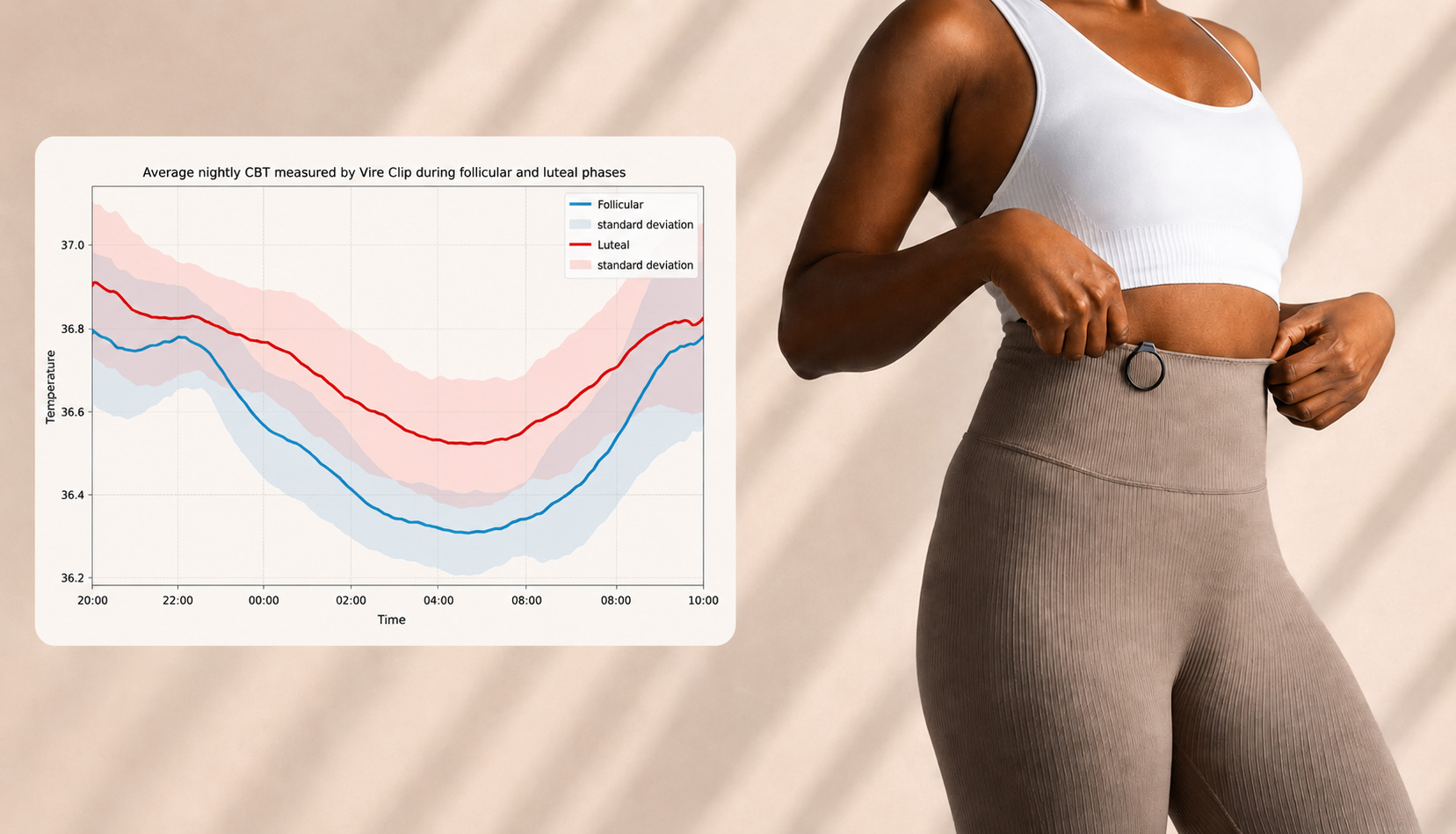
"Temperature shows both the hormonal status, so when is the likely onset time of your cortisol awakening response, and what is the onset of your melatonin in the evening," Immonen explains. He described continuous temperature tracking as the "most comprehensive non-hormonal proxy to those signals".
Each of us has our own distinct, hormonal rhythm – the tempo and timing which can be monitored with the Vire Clip. By observing the subtle, daily rise and fall of core-associated body heat, we may be able to better time and align our daily activities – from eating to sleeping to exercising – with the natural fall and rise of our hormonal waves.
In short, to work with the body, not against it.
Navigating Menopause: Tracking Hot Flashes and Thermoregulation with Wearables
For millions of women entering perimenopause and menopause, thermoregulation suddenly becomes a daily battle. Hot flashes are a sudden, intense feeling of heat caused by declining estrogen levels confusing the hypothalamus.
Vire's technology could provide much-needed data in this under-researched area of women's health.
In addition to measuring heat flux, the Vire Clip measures the evaporation of sweat vapor from the skin. Immonen reveals that the company has "seen promising signs of detecting the sweating periods associated with hot flashes in menopausal use cases". Because traditional wearables on the wrist cannot accurately map whole-body thermoregulation, moving the sensor to the core allows for continuous tracking of these events.
"There hasn't been a continuous measurement of the thermoregulation processes, which are, for example, seen in the hot flashes," Immonen states, marking this as a meaningful, new frontier of study in this under-researched area.
What's Next for the Wearable Industry?
The Vire Clip's launch, scheduled for November 2026, reflects the massive undertaking of pioneering a new biometric standard.
Translating raw heat flux data into actionable, behavior-related use cases is a “long craftsmanship project”, according to Immonen. But by paying attention to the heat we constantly produce and lose, wearables may open a more personal window into metabolism, hormonal timing and thermoregulation.